

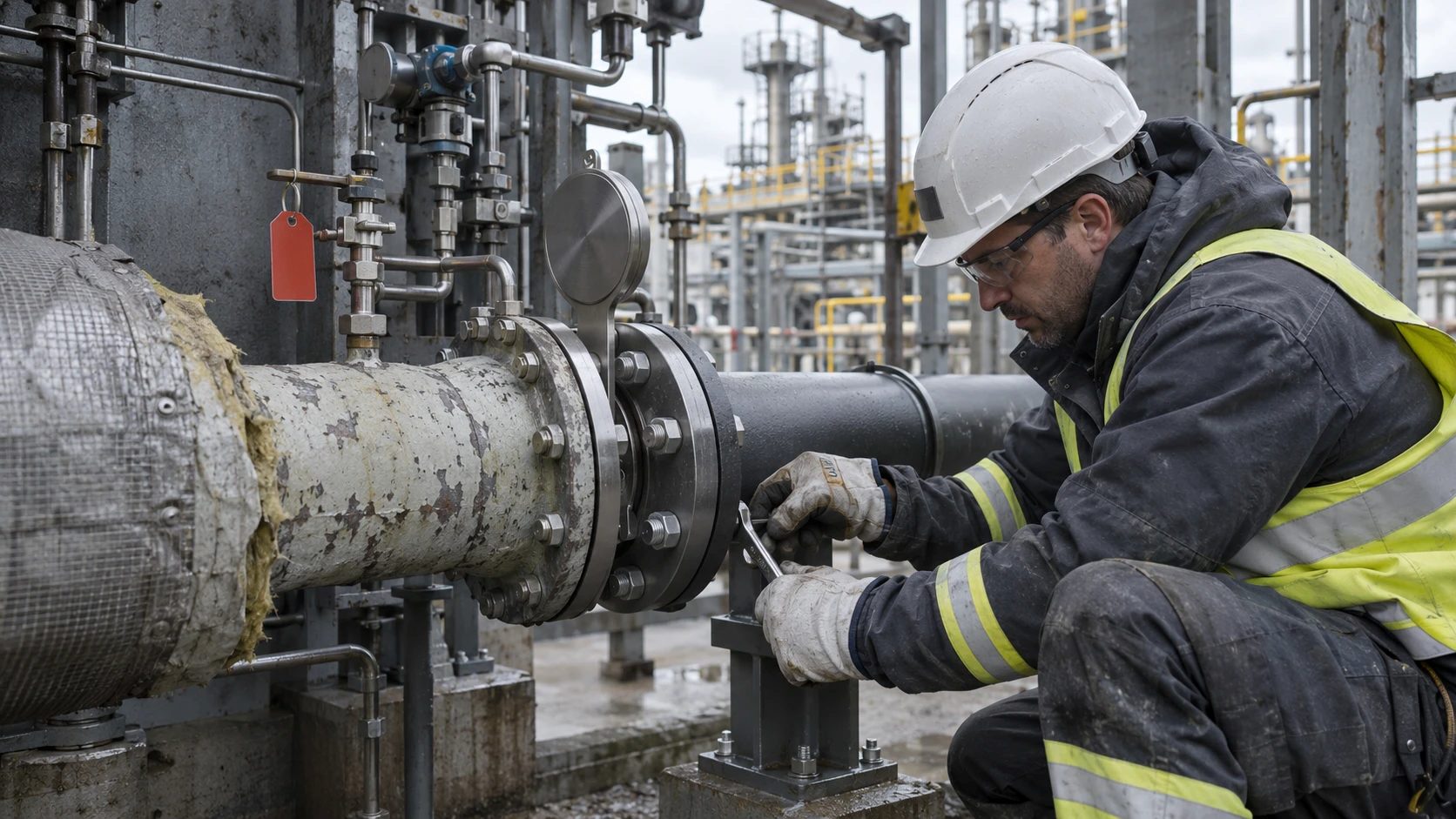
The scope that looks smallest on paper often carries the most execution risk. Tie-ins, small bore lines, flange alignment and quick field changes rarely appear as major activities in the schedule, yet they regularly decide whether a system is completed, tested and handed over on time.
A single tie-in can carry more risk than hundreds of metres of new pipe
The physical scope may be small. The coordination behind it is not. A critical tie-in can require alignment of:
- confirmed isolation and system condition,
- approved drawings and exact field dimensions,
- prefabricated material readiness,
- lifting and access arrangements,
- welding and inspection resources,
- Client or operations availability,
- a clearly defined execution window,
- a contingency if the work does not proceed as planned.
The available window may be measured in hours while the preparation takes weeks. This is why tie-ins should be treated as individual execution packages rather than ordinary installation activities. Every dependency needs an owner. Every prerequisite needs confirmation before the window opens.
Small bore piping can create large problems
Small bore work is often treated as simple, but site modifications can quickly affect quality and documentation. Typical issues:
- impulse lines installed without sufficient support,
- drain and vent locations changed informally,
- small bore connections added without a proper update,
- undocumented field routing changes,
- missing as-built verification.
The solution is simple discipline: control every field change, update isometrics or redlines immediately, verify support requirements and connect modifications with inspection records. Small bore work still belongs to the system and requires the same execution control.
Flange misalignment points to earlier control gaps
Flange alignment problems are rarely isolated mechanical issues. Common causes:
- pipe support position not verified,
- equipment nozzle position not checked,
- forced fit-up during installation,
- gasket and bolt-up sequence not controlled,
- thermal or stress assumptions ignored on site.
Good practice is controlled alignment before final tightening: verify nozzle and flange orientation, avoid forced assembly, check the support condition and perform a controlled bolt-up sequence. Flange alignment is not cosmetic — it protects equipment and system integrity.
Field changes must be controlled from the first decision
Small site modifications can affect stress analysis assumptions, support locations, weld mapping, material traceability, as-built documentation and testing boundaries. A quick field solution can become a documentation problem later.
In congested areas, sequencing matters more than speed
Where space is limited and activities run in parallel — as in offshore and energy environments — improper sequencing leads to restricted welding access, rework due to clashes with structural elements, NDT delays caused by limited inspection windows, and pressure testing bottlenecks. It takes detailed coordination between the structural, mechanical and QA teams.
Speed without coordination increases risk. Construction decisions must remain connected to engineering control.
This article is based on our LinkedIn posts. Follow METAL MASTERS on LinkedIn →