

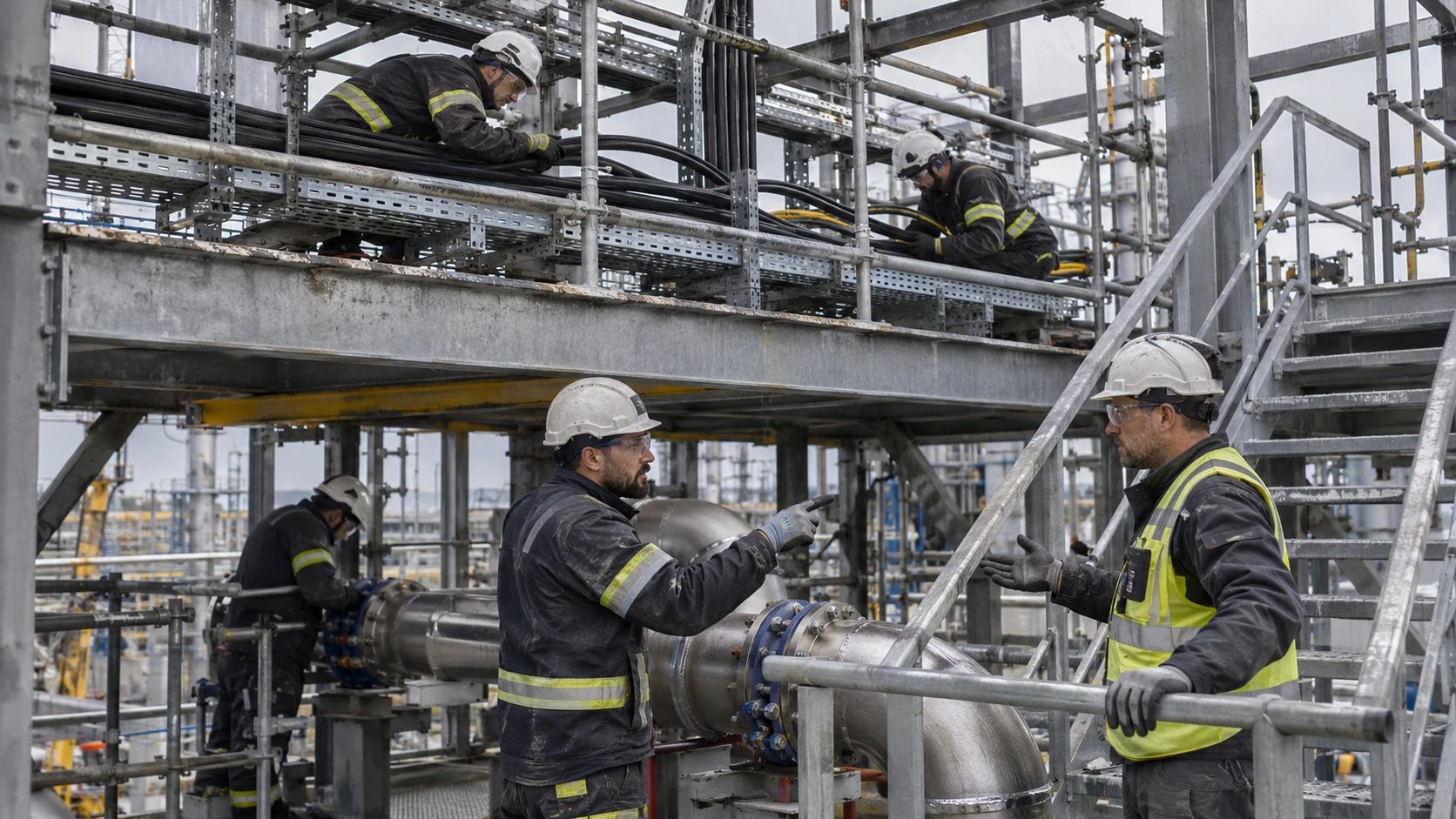
Most execution conflicts are interface failures. Between engineering and construction, risk accumulates quietly. Typical interface gaps:
- IFC drawings updated without field communication,
- late material revisions,
- model changes not reflected in isometrics,
- unclear responsibility between disciplines.
Site teams are forced to adapt in real time, which creates hidden rework and schedule instability. Interface management is not paperwork. It is execution risk control.
Coordination between disciplines is a daily process
Mechanical, structural and electrical scopes overlap. Without coordination, access conflicts appear, sequencing breaks down and delays accumulate. Interface management must be active, not reactive. Coordination is a daily process, not a meeting.
Uncontrolled change destabilises execution
On industrial sites, changes are inevitable. Risk appears when changes are implemented without full communication, documentation is not updated in parallel and field teams work on outdated data. Change itself is not the problem. Lack of control is.
A minor technical modification can create major consequences. A change to piping configuration, support arrangement or installation sequence can influence:
- material quantities and procurement,
- welding and inspection requirements,
- testing boundaries,
- engineering documentation,
- schedule and contractual scope.
Field decisions are often necessary to maintain progress, but execution speed must not replace technical verification and change control. Before implementation, responsibilities, approvals and potential consequences must be clearly established. Fast decisions create value only when their consequences remain under control.
Managing a subcontractor is more than asking for progress
If performance is below plan, repeating “we need more progress” does not solve the underlying problem. Construction management needs to understand what is driving the result: insufficient manpower, the wrong competence mix, poor supervision, low productivity, unavailable material, blocked work fronts, equipment shortage or excessive rework. Only then can a meaningful corrective action be agreed.
The subcontractor must remain accountable for its scope. But effective management also separates contractor performance issues from constraints created elsewhere on the project. Accountability without analysis creates conflict. Analysis without accountability creates excuses. Good subcontractor management requires both.
A contract is also a commitment to time
During execution, reality rarely follows the original plan. Design changes, unavailable work fronts, late materials, additional scope or decisions from other parties can affect the agreed schedule — and this is where disputes often begin. The worst approach is to wait until the end of the project and argue about who caused the delay. A better approach is continuous control:
- maintain reliable progress records,
- document constraints when they occur,
- communicate potential schedule impact early,
- distinguish contractor delay from external dependency,
- agree corrective actions and responsibilities,
- keep commercial and construction teams aligned.
Facts, contemporaneous records and early communication create more room for resolution than accusations made months later. The objective is not to win every argument, but to protect delivery while preserving a workable relationship between Contractor and Client.
Understand the client's delivery logic
The contractor often focuses on installation progress; the client focuses on system readiness and handover. This creates friction: progress reported only by installed quantity while the client expects system completion, documentation not aligned with turnover priorities, punch items managed too late. The solution is alignment around systems, not only activities. A contractor creates value when execution supports the client's commissioning and handover strategy.
Manage expectations before the problem becomes critical
Hiding constraints does not protect the project — it delays decisions. Access not ready, material delivery at risk, limited inspection capacity, a pending design clarification, productivity lower than planned: the answer is early, factual communication. Not excuses, not emotions — facts, impact and a proposed recovery action. Strong cooperation with the investor is built on transparency.
Execution risk rarely appears suddenly. It builds gradually, through repeated minor delays, growing punch lists, documentation lagging behind execution and coordination gaps between disciplines. Early recognition allows control. Late reaction creates pressure.
This article is based on our LinkedIn posts. Follow METAL MASTERS on LinkedIn →