

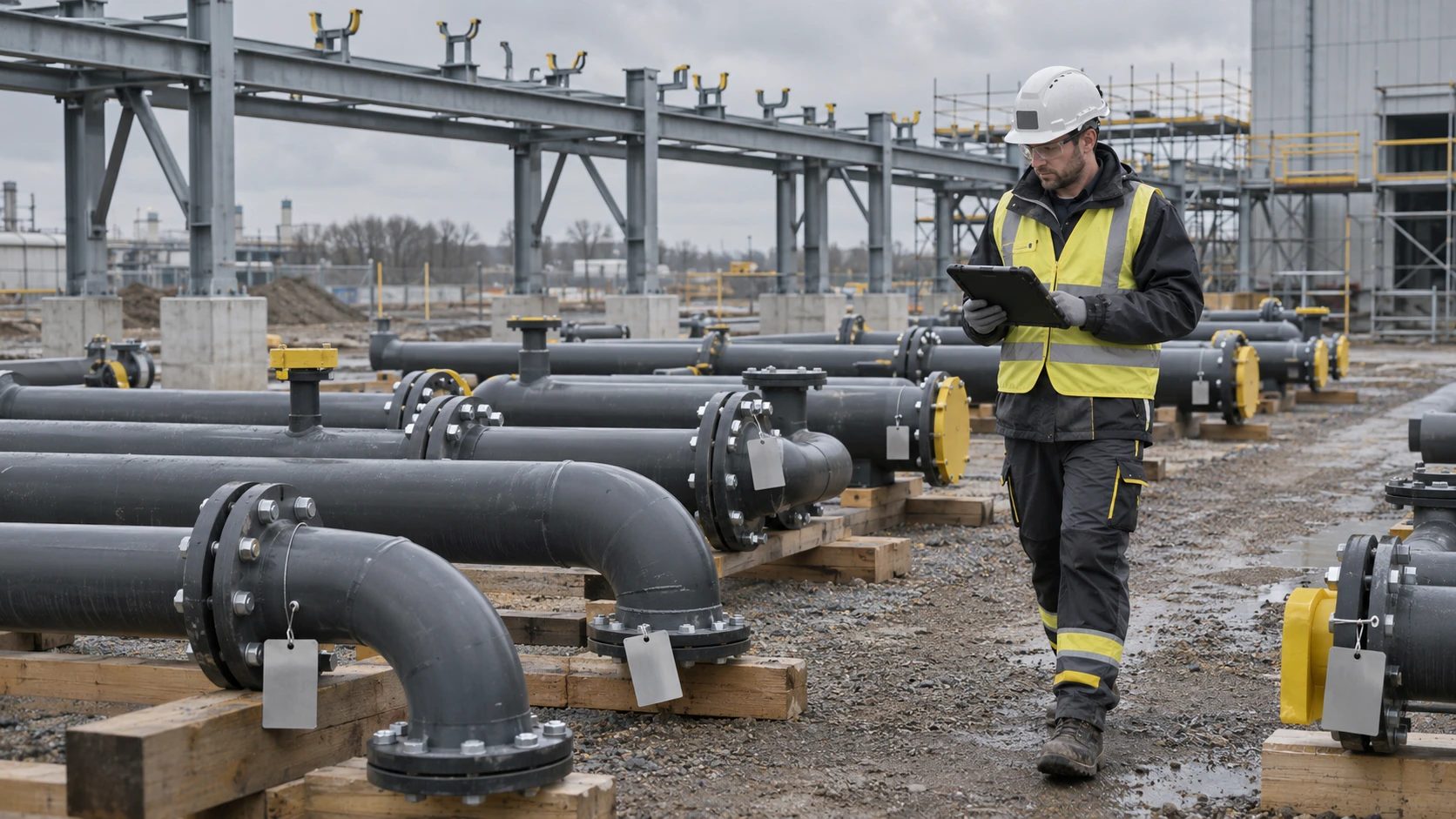
From a construction management perspective, the critical work in piping begins before the first spool arrives on site. Key checks:
- work front readiness,
- support installation status,
- access for lifting and welding,
- isometric release and revision control,
- material availability by system.
When these elements are not aligned, installation becomes reactive.
Work front readiness limits execution speed
In piping installation, productivity is often reduced not by the workforce, but by preparation. Typical constraints:
- incomplete isometric release,
- missing supports or structural readiness,
- delayed material availability,
- unresolved interface conflicts,
- no access for installation and welding.
Without a prepared work front, resources remain underutilised. Execution efficiency starts before the work begins.
Spool installation is logistics, sequencing and access
Spool installation is not only mechanical work. Typical issues on site:
- wrong installation order,
- spools delivered before the work front is ready,
- missing lifting plan,
- limited welding access after installation,
- clashes with steel structure or cable trays.
The correct sequence reduces rework and protects productivity. Piping installation must be managed as a system, not as isolated welds.
Weld access is decided before the pipe is installed
A common problem in piping construction is limited access to field welds after spool installation. Typical causes:
- wrong installation sequence,
- insufficient clearance around joints,
- supports installed too early in conflict areas,
- scaffolding not planned before lifting,
- nearby equipment blocking the welding position.
The solution is not only better welding. It is an access review before installation: a constructability check should include welding, inspection and repair access.
Pipe supports are not secondary elements
Support readiness directly affects installation quality. If supports are missing, incorrect or installed late, the result is usually poor pipe alignment, forced fit-up, welding access problems, additional temporary works and a higher risk of rework.
A pipe system is only as stable as its support strategy. Support control is construction control.
Interfaces need an owner
A piping team rarely works in isolation. Execution is affected by steel structure readiness, equipment positioning, civil openings, electrical and HVAC routes, insulation requirements, and access and lifting conditions.
When no one owns the interface, the site absorbs the problem. Strong construction management means making interfaces visible early.
Good piping execution is prepared before manpower is mobilised.
This article is based on our LinkedIn posts. Follow METAL MASTERS on LinkedIn →